Washington, D.C.
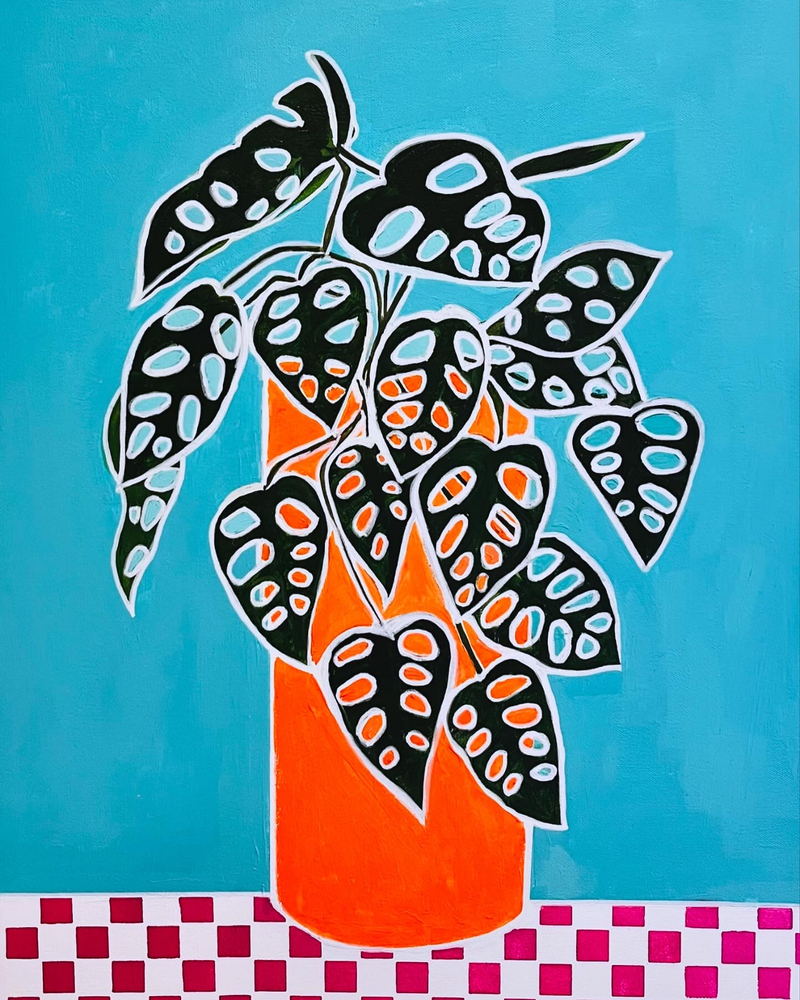
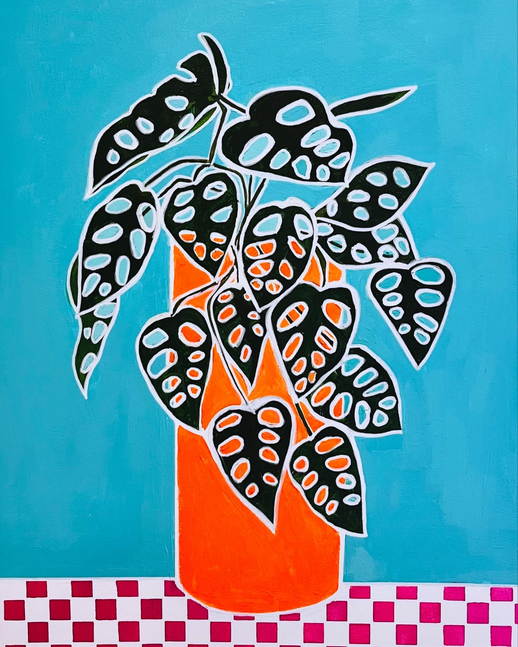
Mini Monstera presents a single potted plant rendered with clarity, restraint, and intention. Leaves are flattened into graphic shapes, outlined decisively and punctuated by repeated openings that function as both botanical reference and abstract mark. The pot is reduced to a bold geometric container. The background remains uninterrupted, offering no illusion of depth or atmosphere. Everything exists on the surface, fully present and resolved.
This painting operates as a concentrated expression of a larger body of work committed to flatness as both a formal and conceptual position. The work resists illusion, gesture, and expressive excess, choosing instead to foreground surface, color, and pattern. Its almost naive quality—its directness, legibility, and calm—is intentional. The painting does not ask the viewer to decode or decipher. It invites looking, recognition, and visual pleasure, while quietly engaging larger questions about how images function now.
Flatness in Mini Monstera is not nostalgic and not ironic. It reflects contemporary conditions in which images circulate quickly, are endlessly reproduced, and are often encountered through screens. The painting anticipates its own mediation. Its clarity survives reduction and translation. Rather than resisting commodification, the work acknowledges it as an unavoidable context and works deliberately within it. The image is designed to live comfortably in both domestic and digital spaces while remaining fully authored and intentional.
The plant functions as both subject and structure throughout the broader practice. Repeated leaf forms establish rhythm and order, creating systems governed by constraint. Within these systems, subtle variation becomes meaningful. No element is arbitrary. Growth is suggested not through expansion or scale, but through refinement and repetition. The potted plant becomes a stand-in for cultivated growth—organic life shaped, contained, and sustained within human-made boundaries.
Color is central to the emotional register of the work. Palettes are bright but disciplined, offering warmth and balance without excess. Joy is not decorative here; it is a considered position. In contrast to cultural expectations that equate seriousness with opacity or heaviness, this work insists that clarity, pleasure, and optimism can be rigorous choices. Visual satisfaction is treated as a valid and thoughtful outcome.
Pattern, often dismissed as merely decorative, plays a structural role across the body of work. In Mini Monstera, the patterned base anchors the composition and references domestic surfaces—floors, textiles, lived spaces. Its presence collapses distinctions between fine art and design, acknowledging the environments where paintings actually exist rather than pretending neutrality.
Taken together, this body of work proposes a painting practice rooted in clarity, repetition, and restraint. Each painting operates as a complete, autonomous object, while coherence emerges through consistency. Mini Monstera reflects this ethos in distilled form: a painting that knows exactly what it is, holds joy without apology, and asserts flatness as a contemporary language capable of meaning, authorship, and pleasure all at once.